On Sale: 11 August 2926
Publisher: Haymarket Books
ISBN:9798888906064
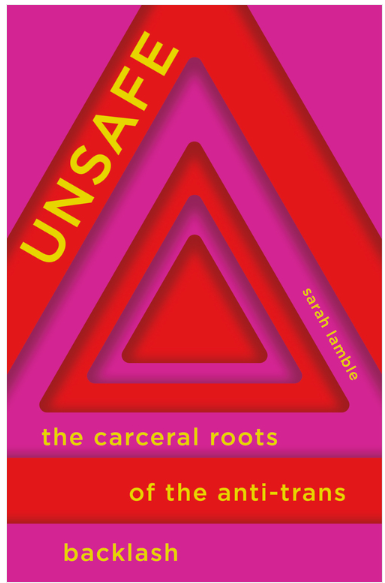
I received an advance reader copy of this book published by the excellent independent press Haymarket Books, who have been a long time favourite of mine for their social justice and political theory books. As a trans man, with an academic background in social science, the book immediately appealed, and as someone who lives on the aptly named ‘TERF Island’, it is particularly pertinent to my life. I am therefore quite pleased that this book in particular is the first non-fiction review on the blog.
First, some author notes- Sarah Lamble is actually Professor Sarah Lamble, and is the Criminology and Queer Theory professor at Birkbeck University, London. Birkbeck is a very cool institution, and for leftwing UK social sciences students it’s basically The Good Place. I mention this factoid so that its understood that Professor Lamble knows their stuff. This book is the studied opinion of an expert, who not only has the academic expertise to back it up, but who has also spent the last 20+ years engaged in feminist anti-violence activism. In their own words:
“Feminist, lesbian, and trans politics have never been separate issues for me, neither in my early organizing work nor in my understanding of myself as a genderqueer.”
Unsafe by Sarah Lamble
Given quite a lot of books about the transgender community have been written by cisgender people, its nice to have something written by someone with skin in the game, for once. And this is a heck of a book.
Lamble starts with the lowdown on the anti-trans backlash in the UK – you can’t understand where things are at the moment (bleak and fairly horrific- the Lemkin Institute for Genocide Prevention has issued a Red Flag Alert for it), without understanding the history of how the last 20 years has seen the UK go from a global leader in LGBTQIA+ rights, to a country trans people are actively fleeing. In 2007, when I first become involved in feminist activism, trans women were a dedicated part of the feminist movement, we knew and understood that gender and gender expression were a wide spectrum, and while there weren’t as many visible trans men as we have now, there wasn’t a disconnect between women’s rights and trans rights. It was just the same struggle. How the hell did we end up here?
Lamble summarises it rather neatly:
“By tapping into concerns about gender-based violence and invoking a sense of women’s shared vulnerability, gender critical groups channelled wider fears of harm into anti-trans positions. Their emotional appeals drew on longstanding cultural tropes that cast trans and gender-diverse people as deviant or dangerous, amplifying public anxieties about trans rights, despite a lack of evidence for such claims.”
Unsafe by Sarah Lamble
Lamble asserts that the gender critical movement is fundamentally a moral panic, and, most importantly that it taps into a much deeper, darker social problem:
“At the center lies carceral safety politics—logics that turn fears of violence into justifications for punitive responses”
Unsafe by Sarah Lamble
This thesis is how Lamble fundamentally ties together 2 interlinked approaches to liberation – gender equality and prison abolition- and the rest of the book is spent talking through how and why carceral approaches to gender based violence are not the answer. Lamble is a much clearer and eloquent writer than I am, and has a background in prisoner solidarity activism that I don’t, but the longstanding work of black abolitionist feminists like Angela Davis and bell hooks is what Lamble is building on here, and which they explicitly credit. Carceral approaches to social violence have not served any of us. Lamble talks at length about the responses in community activism workshops to the question ‘what makes you feel safe’ and as you’ll see when you read the book, the answer is never ‘the police’ or ‘more prisons’.
There are deep seated fears at work underpinning the carceral response of gender critical activists, when they talk about violence against women. While I (unlike Lamble) will call gender critical activists TERFs when the label fits, their assertion that it doesn’t help matters is, I grudgingly accept, correct. Gendered violence is an ever present threat to both cis women and transgender people across the gender spectrum, and no amount of toilet policing or athletic sex testing is going to solve that. Lamble may have managed to write a book that just about holds space for everyone, while trying to build a constructive path towards a solution. It’s certainly a more compassionate approach than I would have achieved.
There are of course, some areas of the book where I disagree. The earlier chapters use ‘non trans’ as a descriptor for cisgender people, which is wierd, and extremely linguistically clunky. I think I’d read 18% of the Kindle version before I found the first usage of ‘cisgender’. I know a lot of gender critical people believe that cisgender is somehow a slur, so I’d wondered if the use of ‘non trans’ was trying to cater to that, but thankfully as the book gets going ‘non trans’ is swapped for ‘cis’.
There’s also this statement towards the end of the book:
To be clear, legal recognition can be impactful. A Gender Recognition Certificate offers formal affirmation and can hold deep personal and political significance, particularly in a world that routinely denies and denigrates trans identity. The proposed reforms would have reduced medical gatekeeping and reinforced bodily autonomy—important principles in their own right. But practically, a GRC changes little in daily life”
Unsafe by Sarah Lamble
Respectfully, I’d like to disagree. As a trans person without a GRC, I can’t marry my partner and have the wedding certificate reflect that I am a queer man. If I die, my death certificate will call me a woman, and there are a host of quibbles about whether I could be legally buried and have that burial record reflect my gender. That’s highly practical, and it is absolutely crap. GRC’s allow our lived reality to be accurately reflected in the administrative record of our lives and that feels really quite important.
Disagreement aside, I think Unsafe is a new vital text in the journey to liberation from gendered violence. For trans communities it is a reminder of the importance pf the practise of solidarity even with people we justifiably don’t like. I hope that for gender critical people it allows them to remember that our search for justice includes them, that gendered violence is as present in the lives of trans people (and is normally perpetuated by the same cis men who are violent to cis women!), as well as see that the answer to eradicating gendered violence won’t be found by banning trans women from the ladies loo, or by calling trans men ‘confused lesbians’. Lamble has managed to combine academic expertise with practical activism and create a truly accessible and highly readable text. Even the great Professor Judith Butler – who is basically the equivalent of my Roman Empire- didn’t quite manage that.
Rating (out of 5): 🛡🛡🛡🛡🛡
Do expect: To have your assumptions challenged
Don’t expect: to have to chew every sentence three times

