The first Chaos Walking trilogy by Patrick Ness lends itself rather neatly to allowing me to launch a slightly different form of book review/regular feature, which I’m calling ‘Series Spotlight‘ – this is for when I want to talk about, well, a series of books, rather than an individual book. I mainly came up with idea so I could spend some time banging on about some of my Ride or Die reads (expect several posts on everything Sarah J Maas has written in the run up to the new books in the autumn), but for the last few days I’ve been reading a new to me trilogy, so that I can read (and then review!) the first book of the second trilogy, which makes Chaos Walking the perfect launch for Series Spotlight.
Book One: The Knife of Never Letting Go
Book Two: The Ask and the Answer
Book Three: Monsters of Men
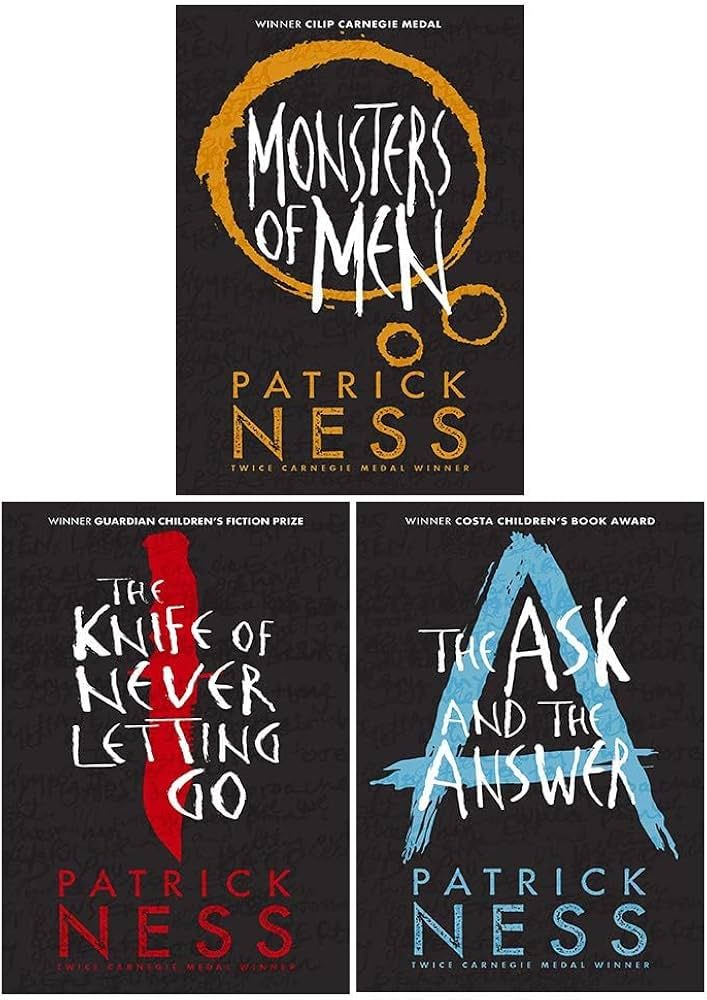
Now, Patrick is not a new to me author, he’s a legend of KidLit and YA publishing and, an actually really lovely human, but I’d not read the Chaos Walking books, and I realised about 6 pages into Piper At The Gates of Dusk, the first book in the sequel New World series that I could struggle to make sense of an already well established world, or, while I have hideous flu and therefore have even less cognitive skill than normal, I could just read the original trilogy and therefore make the new book an even more enjoyable read. So that is exactly what I’ve done.
There are obvious things the books do really well – the character development throughout the series is so skillfully and insightfully done that it is very obvious why all 3 books were Carnegie Medal shortlisted. No single character ends their arc exactly the same as they began it. And that character development isn’t restricted to the main characters either. Even relatively minor characters change throughout the books in ways that feel authentic and deeply human.
Ness doesn’t just limit his character development to the humans. New World has an indigenous society (known as The Land/Pathway/Sky in their own language, but rather derogatively dubbed ‘the Spackle’ by the humans). They too have a complex society that is slowly revealed throughout the trilogy, with character growth I just did not see coming. Even the horses have whole personalities. Despite this though, despite the effort and complexity and skill that it takes to write characters this well, it’s not evident in the reading, because the reading is easy.
A lot of writers who do really elaborate world building, with huge complex characters end up producing books that are ‘chewy’ – you get the vision, but its the reading equivalent of a bowl of granola – delicious, probably good for you, but too big a serving and you get a jaw ache. Chaos Walking is the opposite. Well balanced, beautiful and a treat for the senses. It’s Michelin star dining as a reading experience.
Now, when I say the reading is easy, I don’t mean emotionally. I had to keep putting the books down to go and read something that was the intellectual and emotional equivalent of popcorn, because the plot twists are endless. And well camouflaged. Emotionally, I found myself really distressed for the experiences these wonderful and not so wonderful characters were having, and all the way through the books, the main ‘villain’ would repeatedly do just enough good stuff or take just enough compassionate action that you would find yourself genuinely conflicted about whether he was really the bad guy after all. If you want to answer that question, you have to read the books yourself! It takes skill to write stories with those qualities. And it takes a curious and compassionate human to ask the questions and then explore them in the first place. Which brings me to my next laudatory point…
The philosophical grappling – it is well executed, not conclusively answered and doesn’t distract from the narrative. I spent too much time as a teenager reading Jostein Gaarder books and contemplating catholic theology, while trying to understand my queerness and neurodivergence with no vocabulary to explain either. This means I see philosophical query and moral quandries in almost all texts regardless of who wrote them, though I think in Ness’ case, he did actually do it deliberately. He also executed it almost flawlessly. Each book offers a slightly different set of questions to readers, while building on the questions of the previous book, but its done in such a way that there isn’t a heavy handed moral invective embedded anywhere, the point is to let you consider the question, even if you can’t conclusively or consistently answer it. In a decade that seems to be looking at a more divided, isolated and inhumane society than any other point in my life, I wonder if perhaps everyone should go and read/ reread each book in the trilogy.
Fundamentally, these stories are asking what it means to be a society, what it means to make or break peace with our neighbours, what it means to have a society that functions entirely around the notion of Other, and what leadership in the hard times looks like. Those are big questions, which in 2008 I thought I knew the answers too a bit, but in 2026 I know I don’t. We need to read books that encourage us to grapple with these questions.
I want to have a small list of things I didn’t like about the series , because it feels fundamentally unbalanced to have a review that is effusive in it’s praise, but even the things I dislike aren’t actually negatives. I find the different fonts for the individual perspectives a little jarring, but not enough to stop me reading, and by the third book it was helpful. The only reason I wouldn’t repeatedly reread the trilogy is because I found it so emotionally upsetting. It should upset you, the story is upsetting and rightfully so!
Overall, these are 3 spectacular books, that I can’t reccomend highly enough. Prepare to cry, to rage, to find yourself jubilant and then swiftly distressed when another twist lands, but whatever you do, read them.
Rating (out of five):🛡🛡🛡🛡🛡
Do Expect: Plot twists, tears, a growing sense that Patrick Ness is an authorial GOAT
Don’t Expect: A consistent state of emotional stability, or an obvious outcome

